Coloration


Coloration:

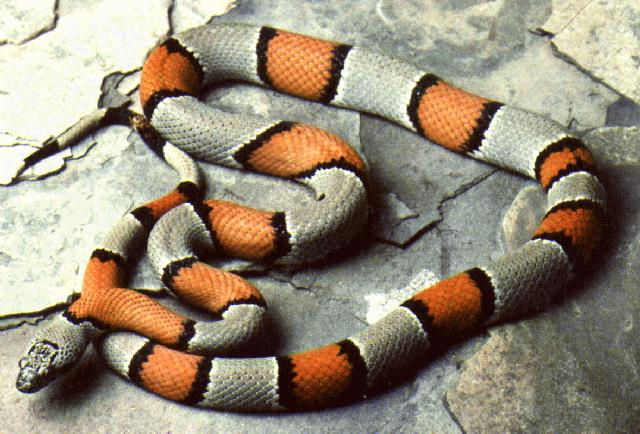
Head: Gray-bands have a well define head with large protuberant eyes. Usually a post-ocular stripe is evident, although it is greatly reduced in some alterna morph specimens. Head color ranges from black tipped, or speckled, to nearly black, or rarely entirely gray.

Dorsal: L. alterna is a highly variable species that sometimes boasts outrageous combinations of bizarre patterned and brilliantly colored specimens. Despite the fact that some animals are clearly intermediate between the "Blair" and "Alterna" morphs, this terminology is still used to describe these reptiles because the variations of color and pattern can be so dramatic that they defy descriptions of any other generalized form. "Blairi" or the wide banded morph refers to the form with large orange saddles and relatively few or no alternate markings, and "alterna" morph refers to the form with reduced primary markings that may or may not be split with orange or red and usually accompanied by alternate markings. "Dark" or "light" phase refers to the general tone of the ground color, which is a highly variable shade of gray.

Ventral: Ventral patterns are equally variable ranging from no pattern (almost white) to almost entirely black, or mottled black and white.

Breeding


Breeding:
A winter dormancy period is required prior to breeding. This dormancy period is often referred to as hibernation or brumation. It is a 10 - 12 week period in which the room temperature is allowed to drop to a constant 55F.
Two weeks prior to the cooling period, it is important to cease feeding and allow snakes to pass all material from their digestive tracts. Clean fresh drinking water should be available at all times. Brumating snakes should be checked regularly for signs of respiratory infections, weight loss and other negative symptoms. Animals that show signs of stress during this period should be removed from hibernation, warmed up and treated accordingly. They may be reintroduced to brumation when their symptoms disappear if time allows.
Breeding may occur anywhere from three to twelve weeks after emergence. The females are placed into the males cage for breeding. Ovulation in females usually occurs after shedding and is evident by a posterior tightness or swelling. Ovulating females are usually greeted rapidly and enthusiastically by males ready to court. Courtship activities can be instigated in non-willing males by placing another male of similar size into the same cage. Combat behavior usually follows immediately.
Four to thirteen eggs may be produced in as little as 30 days after breeding. Gravid females will go through a pre-partum shed about eight to ten days prior to laying. A nest box containing moist sphagnum moss should be introduced to the cage before the female enters this shed cycle. It is not a bad idea to remove the water bowl immediatly after the pre-partum shed so that the eggs are not deposited in it. Clean fresh water must be reintroduced immediatly after egg deposition as the females are usually dehydrated and will head straight for water after laying.
The eggs are incubated in medium of vermiculite and water mixed at a 1:1 ratio by weight. The eggs are partially buried under the vermiculite and incubated at 80 - 82F. 100% humidity should be maintained throughout the 60 - 80 day incubation period
.

Foods


Foods: in nature: rodents, birds, lizards, frogs, snakesin captivity: mice -> pinky, fuzzy, adults, neonates may require lizards, feed medium meal every 4-6 days

Behavior


Behavior:

In the wild, grey-banded kingsnakes are not often encountered. They are uncommon, nocturnal, and quite secretive. Their natural range is sparsely populated with humans and many regions are virtually impassable due to its mountainous terrain. In the field herpetologist community, finding one in the wild is often considered to be a laudable feat. Most that are located are found along the roadways that transect their habitat in the Trans Pecos region.
Alterna generally have a calm disposition and are not prone to defensive reactions, like biting. They feed primarily on lizards, rodents, and sometimes frogs.

Alterna are oviparous, laying clutches 3-13 eggs in early summer, which hatch in approximately 9 weeks. Hatchlings are around 10 inches in size.

Geographical location and Habitat


Geographical Range: found in rocky environments throughout the Chihuahuan Desert from in the vicinity of San Juan del Rio in Durango, Mexico, north to Eddy County in extreme southern New Mexico. In Texas it ranges from Edwards County near Rocksprings, west to the eastern edge of El Paso County in the Hueco Mountains.

Habitat: Rocky canyons and arroyos, limestone ridges, talus slopes and boulder piles are preferred, although specimens are occasionally found in desert flats.

General Information


Scientific Name:
Lampropeltis alterna

Description:
Non-venomous and calm snake
Colourful; alternating colour bands with grey band in between
Nocturnal animal

Size:
Hatchling: 7 - 12 in.
Adult: 28 - 36 in.(normal)57.75 in.(record - Edwards County, Tx.)


Scalation:
Dorsal: 25 rows near midbody
Ventral: 210 - 232
Sub caudal: 56-62
Infra labial:10
Supra labial: 6 - 8
Anal Plate: Single